Autumnal Sacrifice to Confucius
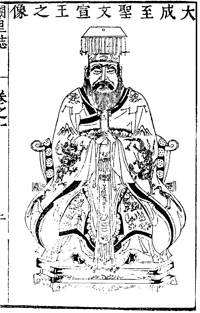 This site is devoted to the Autumnal Sacrifice to Confucius, focusing on providing a video walk-through of the ceremony, as filmed by Brooks Jessup and Thomas A. Wilson in 1998 in Tainan, Taiwan. Each video is accompanied by a brief description of what is happening, as well as some of the historical background and importance. All videos are subtitled in English and a transcript of the translated hymns accompanies the appropriate videos.
Confucianism 儒學 traces its beginnings to the learning of an educated elite that served the royal court of the Zhou dynasty (1134–250 B.C.E.). The learning of this tradition was transmitted in the canonical works known as the Five Classics 五經, which contained the wisdom of five distinctive though intersecting areas of knowledge:
Changes 易 (divination priest)
Odes 詩 (poet, ritual singer)
Documents 書 (scribe)
Rites 禮 (liturgist)
Spring and Autumn Annals 春秋 (historian, chronicler)
The most prominent figure of this Classical learning was Kong Qiu 孔丘, better known as Master Kong (Kongzi 孔子) or his Romanized name Confucius. Kongzi’s teachings gained popularity in the Han dynasty (206 BCE–220 CE) when Confucianism gained favor of some officials at court, though there is little evidence to support the claim that the Han throne extended exclusive favor to Confucianism.
Much scholarship on Confucianism tends to focus on philosophy, but ritual played a central role in Confucian thinking and practice from everyday interactions with members of the family to formal ceremonies performed at the imperial court. Of these rituals, Confucians regarded the Auspicious Rites 吉禮 in the form ritual feasting (or “sacrifice” 祭祀) offered to gods and spirits as the most important. Such rituals operated on the underlying assumption that individuals were composed of two parts, a light yang spirit called hun 魂 and a heavy yin corporeal ghost called po 魄. Upon death, the hun rose upward while the po decomposed into the earth. The main aim of ritual feastings was to honor and offer sustenance to the spirits of one’s ancestors in the afterlife and to the most powerful gods that reigned over the cosmos.
Rites devoted to these gods and spirits were divided into three levels: Great Sacrifice 大祀 offered to the most exalted gods of the imperial pantheon by the emperor, particularly Vast Heaven High God 昊天上帝; Middle Sacrifice 中祀 offered to middle-level gods by court officers in and around the capital and at administrative sites of the imperium, and Minor Sacrifice 群祀 offered to local and regional deities by local officials. Sacrifices to Confucius were ranked as at the Middle level and held twice a year; once in the autumn and once in the spring.
With this website, we hope to serve as a guide through the actions, historical context, and significance of the Autumnal Sacrifice to Confucius, as well as a portal for new information.
The status of the cult of Confucius changed significantly from the earliest official rites devoted to Confucius to ceremonies conducted in the early Republic. The earliest recorded official act that affected the posthumous status of Confucius dates to 478 BCE, when Duke Ai of Lu conferred the title of “Venerable Ni” 尼父 (Duke Ai’s sixteenth reign year), recorded in the Spring and Autumn Annals. The court changed Confucius’s official title to “Exalted King of Culture” 文宣王 in 739 (Kaiyuan 27/8/23) and to “Supreme Sage, Exalted King of Culture 至聖文宣王 in 1013 (Dazhong xiangfu 5/12/29), then finally to “Supreme Sage, First Teacher Master Kong” 至聖先師孔子 in 1530 (Jiajing 9/11/7). This link includes a (relatively) complete chronology of these and many other changes to the cult of Confucius celebrated in the capital, provincial and local official schools, and Qufu, his birthplace.
RELATED RESEARCH
START WATCHING
Begin watching the Autumnal Sacrifice to Confucius filmed in Tainan, Taiwan. With 12 videos in all, these videos take you from the offerings to the final burning of the prayer. VIDEO WALKTHROUGH
Confucian Gods: An Archaeology of Devotional Practice
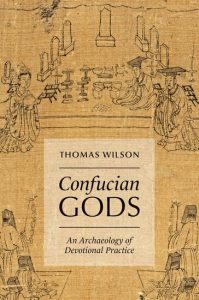
Thomas A. Wilson’s latest book, Confucian Gods: An Archaeology of Devotional Practice (Oxford University Press, 2026).
